
To Pilot, or not to Pilot, that is the question’ that had Shakespeare been a water engineer, he would have posed in Hamlet. The issue of when to pilot, is a subject of perennial debate.
There is an ailment afflicting water technology start-ups, or any company introducing a new innovation to market, called Pilotitis. It’s is a repeat recurring illness, to which there seems to be no immunity, it saps the energy of the patient and can, in extreme cases, prove fatal. It is particularly prevalent, though not uniquely confined to, municipal applciations.
Once-upon-a-time, (quite recently in fact), I was on a call where a Water Utility, was sharing results of a pilot test for an onsite, packaged wastewater system. At first glance, it looked pretty much like any on-site packaged wastewater treatment system I have ever seen. Same chambers, configurations of anaerobic and aerobic etc. Some nice twists, well automated, well designed, just like one car differentiates from another, but a car nonetheless. It did have some unique twists, that made it interesting, including built in electrocoagulation phosphorus removal feature.
As the presentation went on, it became apparent it was a pilot test for a Japanese on-site wastewater treatment system. The company has been around for over 50 years over a thousand units installed of this configuration over the past 10 years.
Now in the Water Technology Adoption Model (WATA), (The Dynamics of Water Innovation), we found it can take on average 3-4 years to complete Pilot Testing and 3-5 years to get your three first full-scale demonstration units up and running.
Here is a company, with 4,000 units installed, the first of which was 10 years ago. Good going.
The pilot test in question, was testing various things, such as what would happen if the hydraulic limits were pushed to 2X the design flow rating.
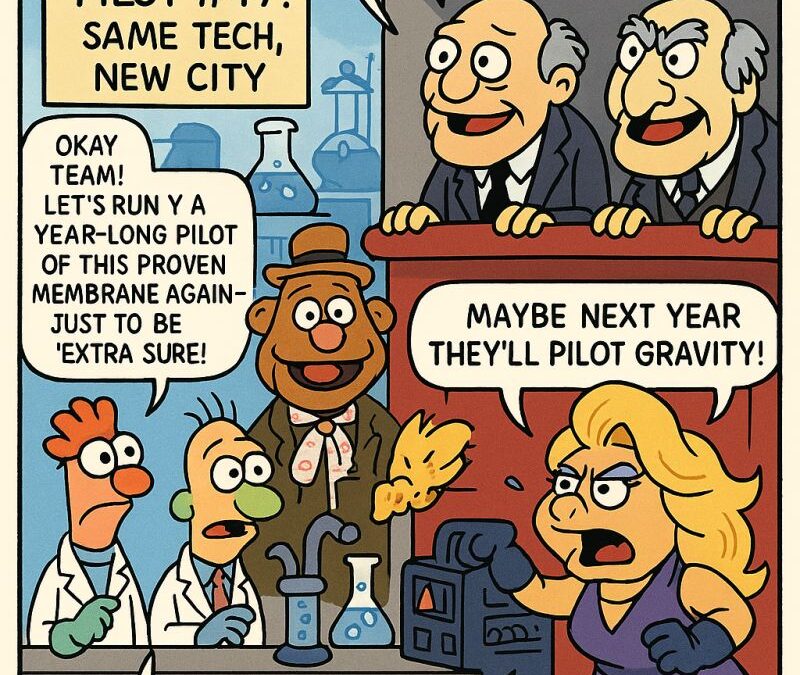
In that one moment, I felt like Statler and Waldorf, the grumpy critics from the Muppet Show. I asked AI to help me to see the funny side of this with a cartoon. I was frustrated as it encapsulated perennial challenges.
Should this be piloted, or purchased? And why take a proven technology and try and push it to 2X design flow. My car tells me how far it can drive on a charge, and I have so far, felt no reason to test out if this was a conservative estimate, and really, it could do a bit more if I just pushed it.
I don’t think we need more pilots, or a shortage of pilot funding is the issue, and I also don’t believe you can write a contract in such a way, that a client has to buy from you if the pilot is successful. That would be like asking someone you are going on a date with to sign a contract to get engaged, so long as you meet certain minimum criteria, like not slurping your soup and being a good conversationalist.
I think we need more sharing of pilot data and this is something we are actively working to do. Finally, I hope the cartoon makes you laugh and see the funny side.