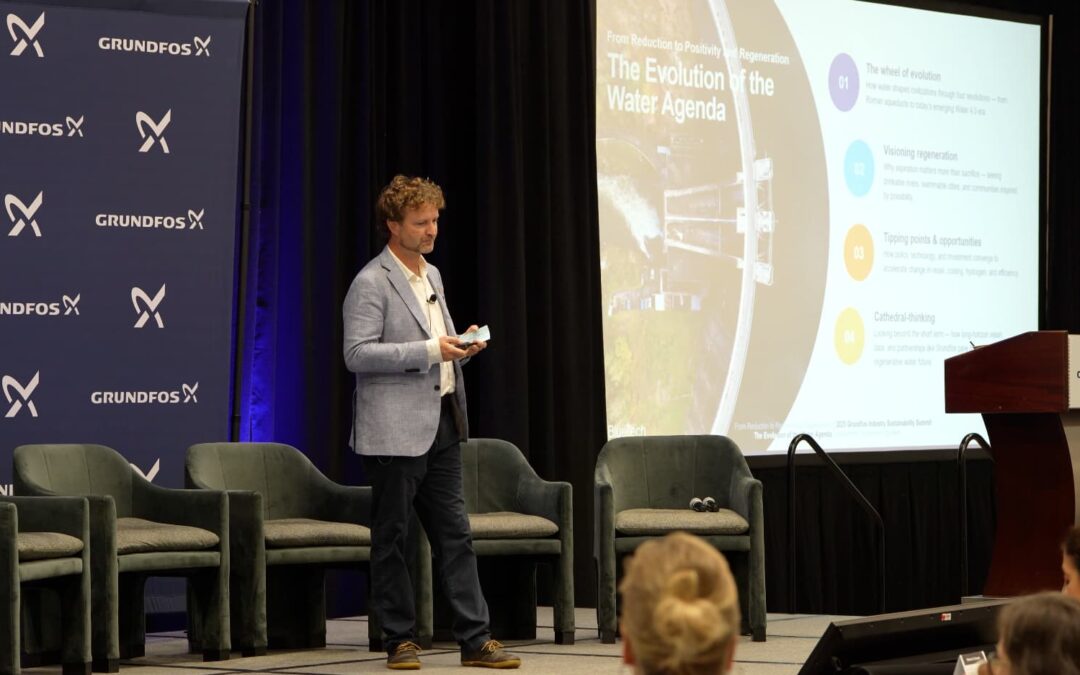
In sustainability circles, the conversation often revolves around reduction — reducing consumption, reducing waste, reducing impact. Yet the most transformative shifts in history have never come from simply doing less. They come from expanding what is possible. In his keynote From Reduction to Positivity and Regeneration: The Evolution of the Water Agenda, BlueTech Research Founder & CEO Dr. Paul O’Callaghan invited the audience to consider a new paradigm: a water future built not on scarcity thinking, but on regeneration. A future shaped not by constraint, but by imagination.
“The wheel is always turning,” Paul began, describing the water sector as one defined by evolution and momentum. “There’s always dynamism. And when enough dots of light appear — enough lighthouse projects — suddenly you reach a tipping point. That’s when the leap happens.”
His argument was not merely philosophical. It was grounded in history, data, behavioural insight, and technological trends: woven together into a story about how water moves from past to future, from reduction to regeneration.
A sector built on revolutions
Water’s journey is one of punctuated transformation. Each leap — from early aqueducts to drinking water treatment, from sewage plants to decentralised systems — fundamentally reshaped society. Paul underscored that these shifts do not arrive gradually. “Evolution doesn’t happen linearly. It happens in jumps.” 
He pointed to the Seine River as a powerful example. Fifty years ago, it was effectively an open sewer. Today, it is clean enough to swim in, not because of regulatory pressure alone, but because people wanted it. “It wasn’t forced upon people. It was something people wanted to have. That’s when €4 billion gets mobilised.”
This is the essence of regeneration: progress sparked by desire rather than deprivation.
The power of visioning: imagining regeneration into existence
From Paris, Paul moved into the role of imagination in driving environmental outcomes. He recalled recent visits to immersive exhibitions in Nashville, London, and Vienna — experiences designed to evoke empathy and visceral connection to water. These artistic interventions, he argued, serve as catalysts for change.
One example came from New York, where artist Mary Miss collaborated with the Department of Environmental Protection to help residents visualise a greener future. Tapestries were created showing apartment buildings transformed with green roofs and daylighted waterways. People could walk in, see the futurescape, and say, I want that.
“They began to imagine it before it was there,” he said. “That’s the power we have if you want to do it — if you get people on board — it’s magical.”
He shared another story from Mesopotamia, where wetlands are being rebuilt using patterns inspired by ancient wedding dresses — ecological engineering infused with cultural meaning. In both cases, art served as the bridge between technology and community, transforming environmentalism from a burden into an aspiration. “Environmentalism must feel like aspiration, not sacrifice.”
From Lighthouses to Tipping Points
Beyond imagination lies the path to scale. Paul described how BlueTech tracks “lighthouse projects” around the world — early examples demonstrating what is possible. Whether it’s Nike reducing water use in Mexico or Apple using aquifer recharge to sustainably cool data centres in Oregon, these projects offer glimpses of the future.
The key, he explained, is not the number of lighthouses themselves, but how they accumulate. “When about 15–25% of a group moves in a certain direction, you reach the tipping point.” 
Paul has witnessed this firsthand. Early in his career, membrane bioreactors were abstract concepts discussed in academic circles. Two decades later, they are a multi-billion-dollar global market. The same pattern is now emerging in direct potable reuse, aquifer recharge, energy-neutral wastewater treatment, and radical decentralisation.
Regulation plays a pivotal supporting role. Policies emerging across India, France, California, and the European Union are no longer merely restrictive; they are enabling. The EU’s requirement for energy-neutral wastewater plants by 2040, for example, is not a theoretical ambition. As Paul noted, dozens of plants already meet this standard. The regulation signals to industry that the future has arrived — and invites them to participate in building it.
The expanding universe of water innovation
From there, Paul turned to the landscape of innovation — an area where BlueTech’s global intelligence platform provides unique visibility. “Water is not one thing. It’s a collection of disparate systems — physical, chemical, biological, biochemical, and increasingly digital.” 
BlueTech tracks approximately a thousand active companies at any given moment, categorising technologies, mapping trends, and assessing disruptiveness. Sensors and control systems, once a niche, now represent one of the fastest-growing segments. Membranes continue to evolve. New treatment, sensing, and recovery technologies are emerging at an accelerating pace.
Paul highlighted the role of machine learning in identifying patterns that correlate with successful technologies. By analysing a decade of data on company performance, IP defensibility, business models, market timing, and team profiles, BlueTech is working to understand the underlying signals that predict impact.
His message was clear: innovation in water is not random. It follows identifiable patterns — and understanding those patterns is essential for accelerating the next generation of solutions.
Market creation, Market taking, and the path to scale
One of the most practical insights came in Paul’s explanation of how new technologies enter and reshape markets. Using a two-axis framework — market-creating vs. market-taking, and crisis-driven vs. value-driven — he illustrated why some technologies move quickly while others require slow, steady nurturing.
PFAS is a classic example of a crisis-driven market. Without regulation, PFAS sensing and destruction technologies would have no customers. With regulation, demand spikes almost overnight. Value-driven technologies, such as ceramic membranes or energy-efficient aeration devices, may move more slowly, but often prove more durable.
He offered an example directly relevant to innovators: “Aquacycl is creating a new market because it allows companies to do things on site that weren’t possible before: reducing off-site waste, reducing disposal costs, reducing the cost to the client. That’s value-driven and market-creating.”
This clarity helps innovators position themselves realistically and strategically, knowing whether their fate hinges on regulation, value, or both.
Regeneration as a research frontier
Many of BlueTech’s upcoming research topics centre on regeneration. From direct potable reuse and greywater recycling to bipolar membranes that recover chemicals on site, the future of water is circular and restorative.
Paul noted one area that surprised even his team: the sudden acceleration in ammonia recovery technologies. “It was there for about 10 years, but now it really seems to be taking off,” he observed. 
This emerging frontier reflects the sector’s gradual shift from minimising impacts to designing systems that replenish, restore, and renew.
In the latter sections of the keynote, Paul explored the emotional and cultural side of water. An area often undervalued in technical discussions.
“We’re not creatures of logic as much as we’d like to think. We’re creatures dominated by emotion.”
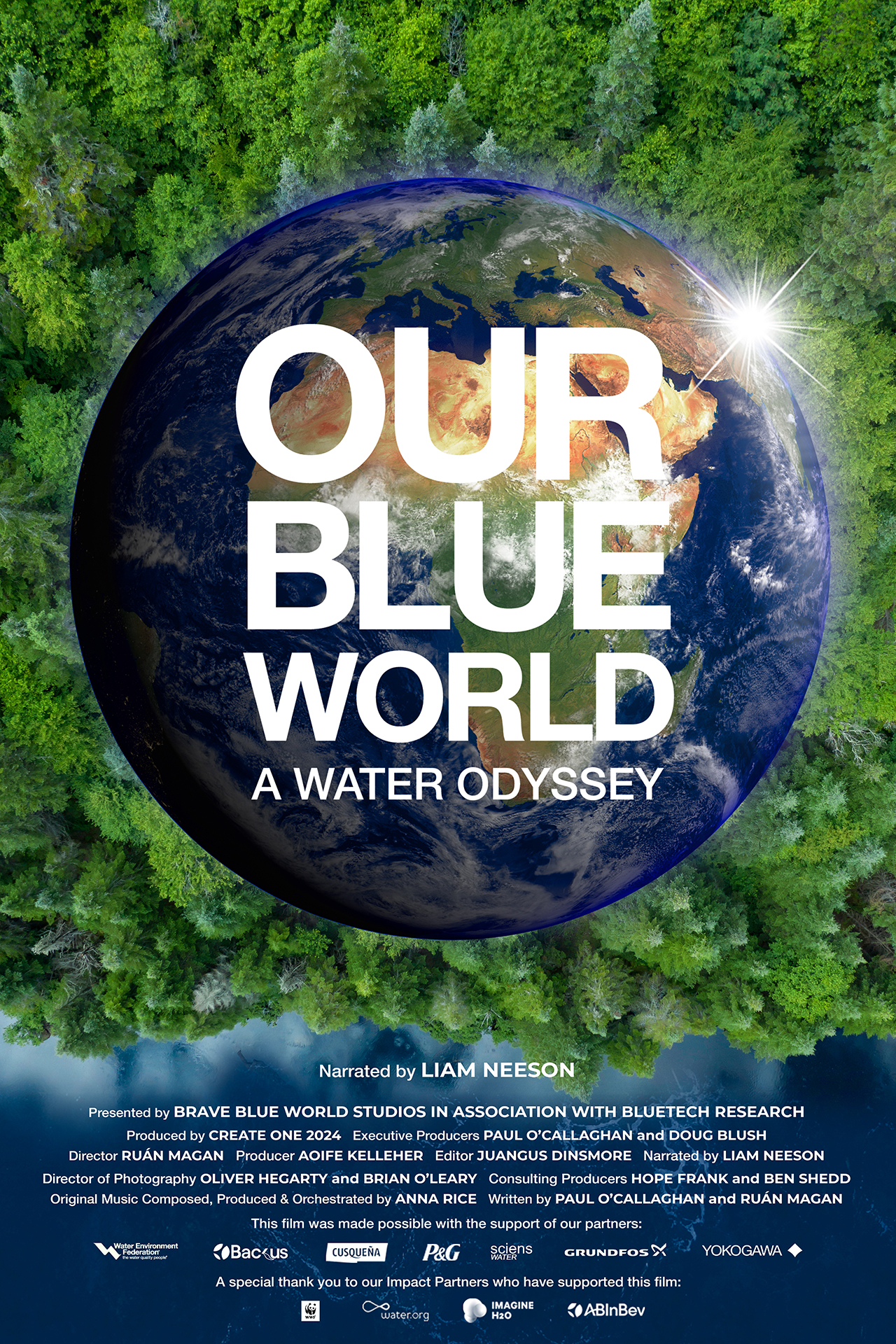
This is why Our Blue World, the documentary produced by Paul and supported by the Grundfos Foundation, plays such an important role. While the film showcases technological pioneers, its deeper purpose is to reconnect people with water, highlight its cultural significance, and reignite a sense of wonder.
Stories of drinkable rivers, sponge cities in China, legal personhood granted to waterways in New Zealand. These narratives shape public will in ways that data alone cannot. The film’s impact, with screenings in more than 30 countries and multiple awards, demonstrates the global appetite for stories that inspire action.
Cathedral thinking: building for futures we may never see
Paul concluded with a metaphor that has timeless resonance: cathedral thinking.
He described great engineering feats such as the Erie Canal and architectural wonders like Barcelona’s Sagrada Família — projects undertaken with time horizons that stretched well beyond the lifetimes of their creators.
“Our forefathers thought in decades. In centuries. They started projects they knew they would never see finished.” 
Cathedral thinking is the mindset required to address water’s greatest challenges. It means designing systems that endure, planning for future generations, and resisting the gravitational pull of short-termism. It means building platforms, governance structures, and ecosystems that can move steadily toward regeneration even as leadership, politics, and markets shift around them.
In Paul’s words, long-term vision is where “the great things” are achieved. 
A regenerative horizon
From ancient cisterns to modern aquifer recharge, from tapestry-driven visioning to machine-learning insights, from lighthouses to tipping points, Paul’s keynote offered a sweeping yet grounded view of how water can move beyond reduction toward regeneration.
The message is ultimately one of possibility.
Regeneration is not just a hope. It is a direction of travel already visible in policy, innovation, culture, and community imagination. It is a shift from scarcity to abundance, from mitigation to creation, from efficiency to flourishing.
And as Paul reminded the audience: “If you want to do it — if you get people on board — it’s magical. And it moves us from reduction to regeneration.”