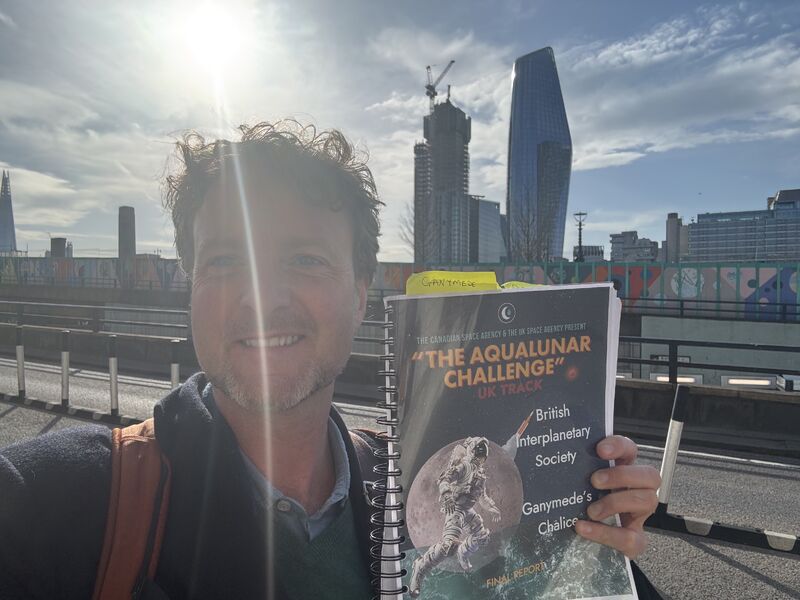
It’s not every day you get to meet an Astronaut and spend a day assessing technologies to make water on the dark side of the moon. (Yes, there is frozen water on the moon, tied up in frozen regolith, moon rock. But there are also lots of impurities, more than I would have thought, methanol and ammonia, for example and many others organic compounds. We reviewed 10 short-listed submissions, in the Aqualunar Challenge, expertly run by Nesta.
The challenges were first, its very cold during the lunar night, -200 deg C. The moon dust and rock, is extremely problematic from a materials handling issue, Its a vacuum and the gravity is one sixth of that on earth.
Generally the first step, is melt the regolith to create a liquid and solid phase, or sublimate the water and contaminants. (Generally powered by small nuclear batteries, or alternatively solar panels). After that it’s how to separate the rock and destroy or remove the contaminants and produce 1 L of water per hr of drinkable quality. Across 10 Submissions, we had a huge range of permutations and combinations, a kaleidoscopic cornucopia including MF, UF and RO membranes, activated carbon, supercritical water oxidation, RF Plasma, Freeze distillation, multiple effect distillation, ultrasonic cavitation, electrochemical water oxidation with boron doped diamond electrodes, UV Titanium dioxide photocatalytic oxidation, vortex separation, multiple effect distillation, and shock electrodialysis, which was new to me. It was quite something. I erred towards favouring things that would work, reliably, with less unit processes and moving parts. Having said that, there was also the recognition that this is a moon-shot, literally, and it’s an opportunity to try things that might not be economically viable on earth. So we looked for a balance.
The applications came from universities, from small tech incubators, space companies and even some family teams including a father and his two sons, who came up with some pretty novel and outside-the-box ideas, including the idea of dropping their test-rig from a weather balloon in a field on bungee chords to help simulate the lower gravity on the moon.
There was an expert panel, including Vanessa Speight, a water researcher and academic from the University of Sheffield, astrophysicists, space exploration scientists and astronaut David Saint-Jacques.
I enjoyed the day immensely and was enthralled to hear David’s first hand experiences of living on the International Space Station. He very generously shared some common misconceptions of life on the ISS, over lunch. Perhaps one of the most notable comments, was how convenient gravity is, as it holds things in place, when faced with the problem of constantly losing things that you place mid air that just drift off in air currents!
Thanks to Kim Wu, for her expert help in reviewing the submissions.
Now, back to solving water on this beautiful hospitable planet.