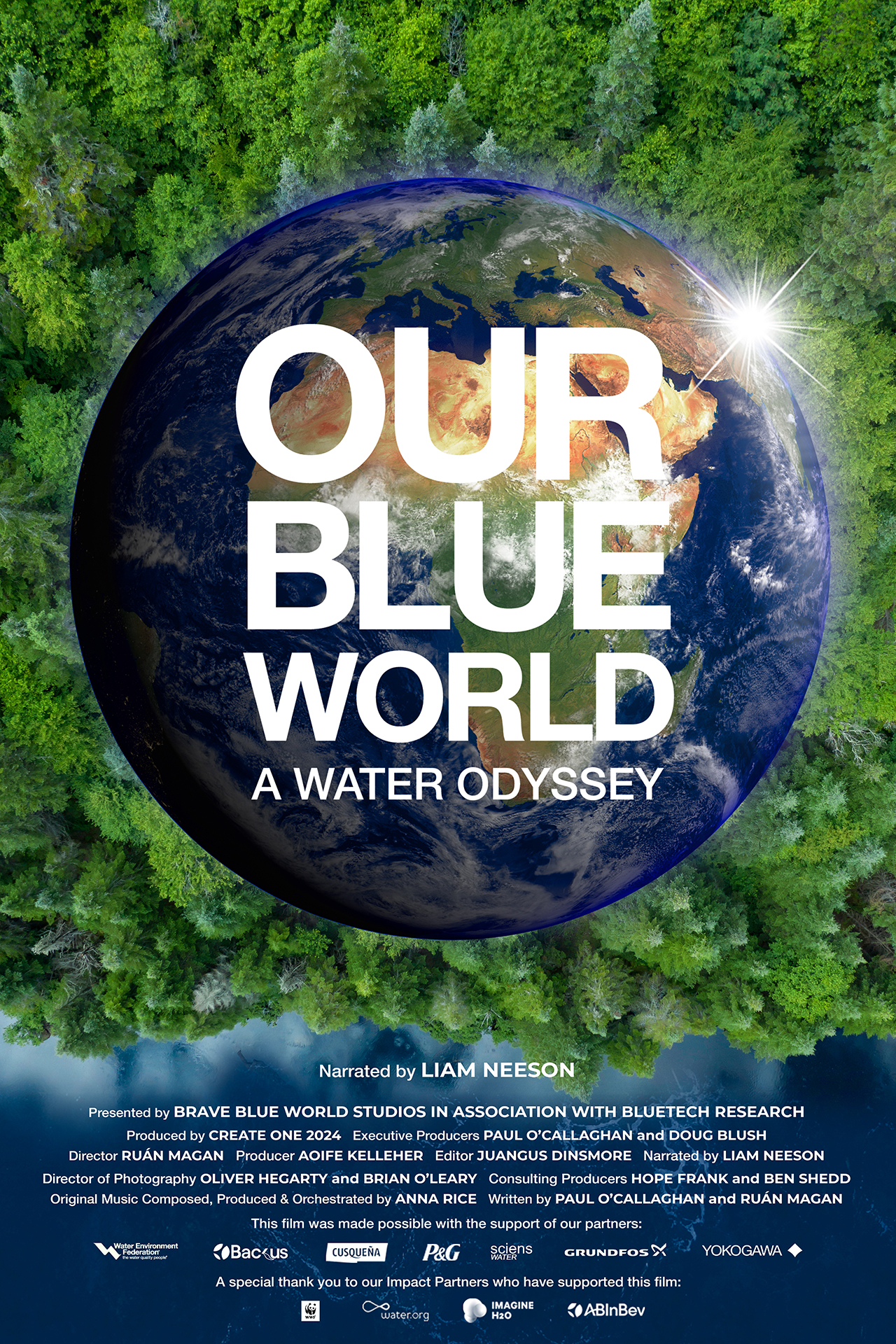
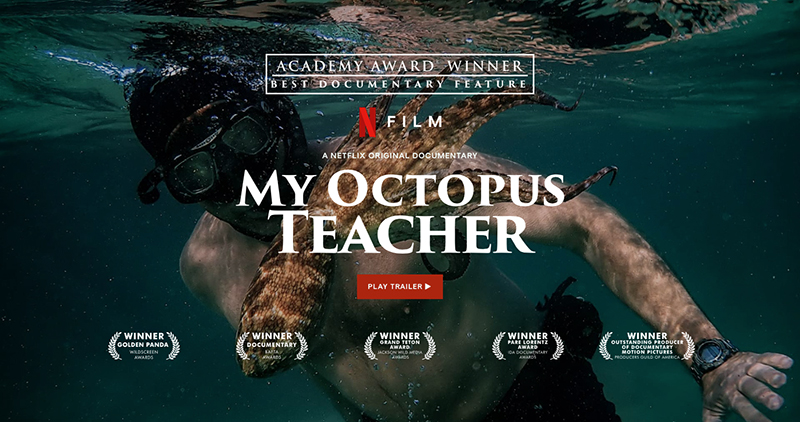
Ever since the launch of Brave Blue World, the question comes up, ‘So, what next?’ I went walking the Camino de Santiago this summer to give that question some thought. I started to think about which documentary films have I not only learn things from, but which truly changed me. The one that stood out, was My Octopus Teacher. Having watched it, I will no longer eat Octopus. Because of the empathic relationship the lead protagonist developed with a sentient being. And although it was not my relationship, I related to it and that had an impact on me. When I tell people this story, almost everyone has the same reaction, ‘me too!’
That got me thinking about how to tell an intimate story about the human relationship with water, one that puts us at the centre of it, about who we are, where we come from, and what we believe in. It is said that ‘water is life’, and equally, ‘life is animated water‘. One of the roots for the word ‘water’ comes from the Sanskrit ‘apah’meaning to animate. This has survived in modern Irish word for river, Abhann.
Alok Jha, in The Water Book, notes ‘Water is the only natural substance in which we have invested so much culture and holiness. The human relationship to water is complex, multi-dimensional and like a fractal, infinitely more intricate the closer you look. Water courses through us, our societies and our planet
Thiscan be seen through the eyes of people who have had transformative experiences addressing global water challenges.
The challenges are clear, and include combatting deteriorating water quality, addressing water scarcity, providing global access to water and sanitation, dealing with the problem of too much water and the food and water nexus. There is no single solution to any one of these challenges, it requires a thousand solutions. But solving any of them starts with valuing water. Everything else flows from there.
Human civilisations grew up on the the banks rivers and our sense of identity and place is often linked to the world’s great rivers. If you are Indian, you identify with the Ganges, the Indus and the Bramiputra. In Chinese culture the Yellow River, the Yangtse the Pearl play central roles. If you are from Colombia, it’s the Magdalena river. Rivers are living entities with beautiful stories, personalities, a link between our past and our future.
This is why the Drinkable Rivers movement, led by the charismatic activist Li An Pho has such a strong currency and hold on our imagination. It’s a positive message, that strikes at the heart of our relationship with rivers. In the hyper local world of water, it’s a unifying idea that citizens everywhere can embrace and rally around.
In terms other unifying elements of the human relationship with water, in all of the world’s great belief systems, water plays a central role. Whether you are a Hindu, a Jain, a Baptist or a Jew, follow the teachings of Islam or practice Buddhism, water plays a central role in origin stories and creation myths, rights and rituals, purification and rebirth and the journey to the afterlife. Norwegian writer Terje Tvedt provides perhaps the most in depth overview of this in his fascinating book, ‘Water and Society’.
Water & The Afterlife
In the Qur’an metaphors about water are frequently used to symbolise the afterlife in Paradise. There are frequent references to Cooling rivers, fresh rain and fountains of flavoured water in the gardens of Paradise. Water is the essence of the gardens of Paradise. The believers were to be rewarded with ‘rivers of un-stagnant water’ Qur’an 47:15
In Hinduism the river provides the mythical path leading to Nirvana,which is why the ashes of the dead should be scattered in a holy river.
In Sri Lankan Buddhism, merely to look at water was considered to be cleansing. In many religions, bathing symbolises rebirth; it is a method of renouncing one’s former self.
“It thus an undeniable fact, that the physical water environment is often conceived of as a holy and cosmological landscape, invested with divine meanings, where the profane is interwoven with the sacred. Rivers, or bodies of water, for example, often have the role of marking the end of the profane and the start of the divine journey”. – Terje Tvedt, Water and Society
Moreover, the nature of the water in our environment has shaped our philosophical thought. In Hinduism and Buddhism there is no ultimate destruction of dissolution, it is a continuous cycle of creation, dissolution, and recreation from the dissolved condition. The whole cycle, in these religions resembles the seasonal pattern of birth and destruction that has been characteristic of ‘Monsoon Asia’ and where the floods have tended to be very destructive, setting land under water for weeks and months on end, but at the same time being very necessary to ensuring that the land is fertile at the start of the next growing season.
The entire cultural, political and philosophical history of the China can be seen through the lens of water, as Philip Ball outlines in ‘The Water Kingdom – A Secret History of China’. The fitness rule was deemed to go hand in hand with the ability to manage water in a land where the rivers could be so unruly as to have been given names such as China’s Sorrow and the Scourge of the Sons of Han. Alok Jha reminds us in The Water Book, that the Chinese symbol for ‘political order’ is made up of the characters for ‘river’ and ‘dyke’ and the meaning is clear, whoever controls water controls society. Control of water allowed empires to grow in previously unprecedented scales.
‘Water is the highest good’, wrote Lao Tzu in the Dao de Jing, the foundational work of Daoism. “Water. Oh Water!” Wrote Confucius rather cryptically, leaving it up to others to interpret what he meant. Joseph Needham writes ‘the whole of Chinese theoretical thought came to be permeated by certain ideas proper to the control of water courses, so important a feature of the civilisation’.
The concepts of Yin and Yan have a relationship with water as Philip Ball describes:
‘There is a particularly beautiful aspect of the yin / yang dialectic the runs though Chinese thought and artistic expression, namely the contrast of the mountains and water, Shan and shui. The (male) mountains are permanent, symbolising space; (female) waters is changeable, a symbol of time. Mountains rise, waters descend. But they are symbiotic: rivers begin in mountains and they are sculptors of mountains. In this way, shan and shui can represent the entire cosmos.’
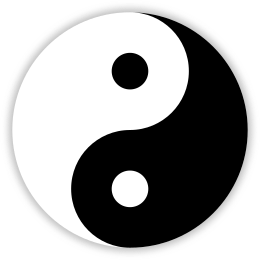
In the Tao Te Ching, Lao Tsu wrote, that ‘there is nothing softer and weaker than water’ and yet, ‘there is nothing better for attacking hard and strong things’
In present day China, the concepts of Sponge Cities and Ecopuncture, borrow upon ancient wisdom and one advocate, Dr. Yu Kongjian has made it his life’s work to help persuade Chinese leaders to return to this more natural way of dealing with water in the urban setting.
All over the world people are looking at our historic relationship with water to a source of inspiration to divine a pathway through the current water challenges we face. The pre-Incan water canals, the Amunas, that ensured a year-round supply of water for Machu Pichu, are being restored in Peru to help provide water for modern day Lima.

The Amunas in Peru
The replenishment of groundwater aquifers with re-used water in Orange County California is reminiscent of the Qanats built by the Persians all along the Silk Road, as a way to harvest renewable groundwater resources sustainably. The use of digital and satellite data to manage rainwater capture in Talking Tanks in Melbourne Australia, combines internet of things with the practices of rainwater capture that go back as far as the lost Indian City of Dhoilavara.
If we view our cultures and belief systems as flowing from water, we identify with water in a very different way. We become empathic to it in a way that is rooted in a deep sense of self and a sense of place. Following the interlinking transformational journeys of protagonists around the world, that tie together a rich cultural, historic and personal narrative may be equivalent of My Octopus Teacher for Water. I’m already enjoying the journey myself.
Water is life. And Life is Animated Water.